The desirability of holding simultaneous elections for the Lok Sabha and Vidhan Sabhas has been discussed at various levels. A considered view is that simultaneous elections will ...
The desirability of holding simultaneous elections for the Lok Sabha and Vidhan Sabhas has been discussed at various levels. A considered view is that simultaneous elections will not only keep alive the enthusiasm of voters, but will also result in huge savings to the public exchequer as well as avoiding repetition of administrative effort. It is also expected to control the expenses of political parties. Simultaneous elections will also avoid repeated enforcement of the Model Code of Conduct which affects administrative actions by the government.
President of India, His Excellency Shri Pranab Mukherjee has also expressed his views on the desirability of holding simultaneous elections. Speaking at a recent function, The President said that “With some election or the other throughout the year, normal activities of the government come to a standstill because of code of conduct. This is an idea the political leadership should think of. If political parties collectively think, we can change it.... The Election Commission can also put in their idea and efforts on holding the polls together and that will be highly beneficial”
Hon'ble Prime Minister Shri Narendra Modi has spoken several times on considering the feasibility of holding simultaneous Lok Sabha and state assembly elections. In two recent TV discussions, the Prime Minister reiterated this idea and invited a national debate on the issue.
Debate on the Issue - A Brief History
In India, simultaneous elections to the Lok Sabha (House of The People) and Vidhan Sabhas (State Legislative Assemblies) were organized in the years 1951-52, 1957, 1962 and 1967. Thereafter, however, the schedule could not be maintained and the elections to the Lok Sabha and the Vidhan Sabhas have still not been realigned.
The next General Election to the Lok Sabha is scheduled for 2019. Elections for the Vidhan Sabhas of 5 States are scheduled for 2017, for 13 States in 2018, for 9 States in 2019, for 1 State 2020 and the remaining are scheduled for 2021.
The issue of simultaneous elections was debated by the Law Commission in its 107thReport in 1999 (Reform of Electoral Laws) , where in it was mentioned that – “The rule ought to be one election once in five years for Lok Sabha and all Legislative Assemblies” ( Para 7.2.1.1 of the Report). Recently, Parliamentary Standing Committee on Personnel, Public Grievances, Law and Justice presented its 79th Report on ‘Feasibility of holding Simultaneous Elections to the House of People (Lok Sabha) and State Legislative Assemblies’ on 17th December 2015.
Several structural changes will need to be done in case a decision is made to conduct simultaneous election, including possibility of Constitutional amendments to Articles 83, 172, 85 and 174 to streamline the process.
Seventy Ninth Report Parliamentary Standing Committee for PERSONNEL, PUBLIC GRIEVANCES, LAW AND JUSTICEMyGov Discussion
MyGov invites citizens, Parliamentarians, Members of Legislative assemblies and councils, constitutional experts, academics experts, bureaucrats, social media influencers, Think Tanks and all other interested people to give their considered view on the subject. The issues that can be considered while formulating a view are (only an indicative list and not exhaustive):
1. Is it desirable to hold simultaneous elections? What are the pros and cons?
2. If simultaneous elections are held, then for the first time what happens to assemblies whose scheduled tenure either ends before or after the proposed date of holding elections?
3. Should the term of Lok Sabha and assemblies be fixed?
4. What would happen in case by-elections are necessitated in between terms?
5. What happens in case the ruling party or coalition loses majority in between term, either in Lok Sabha or in State assemblies?
You may submit your opinion by either writing in the comment box below, or by attaching a PDF document, or through a Youtube video.
The last for submitting your opinion is 15th October, 2016.
This is a wonderful initiative taken by the Hon.Prime Minister. This saves lot of expenditure to the Government. It also saves lot of tome to public representatives and law makers to think over such initiatives in future for overall development of the country. Everyone should support this as the Hon. President of India has already commended it.
Sir, All election from Panchayat to Parliament can be held in Nov/Dec. 2023.Weather will be suitable throughout country, no exam schedule for students either. Curruption tgrough fund raising for all parties will thus be only once in 5 years, instead of for every election held on annual basis. In case of hung election results, formation of a national Govt will have to be mandatory. Even4 no confidence motion adopted, this option only be made available by law. All elections now on Bvalid tillNov23
i am much supportive to this initiative to discuss the simultaneous elections for Lokshabha and vidhan sabha,As it will stop the drainage of giant wealth to cunduct elections all the time for different states and will also increase the focus of govts. towards developement rather to play political games,rallies etc for upcoming elections.
Hope for such progressive changes to our political systems.
In my opinion holding elections of Lok Sabha and Vidhan Sasabha toghether is quite desirable
the reason being control in Govt expenditure, concentration in state's as well nation development process, healthy decision making process and last but not the least strengthen our democracy with voters power
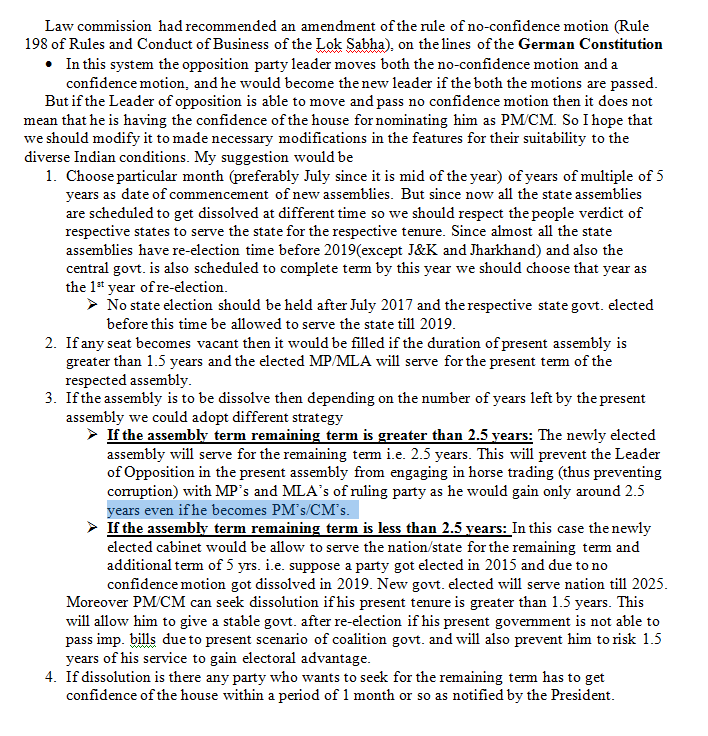
yes simultaneous elections are desirable and my views on the procedure are enclosed in the png file
Moreover regarding this site doc file attachment should also be provided as genrally the comment section is not providing enough space
It is desirable to hold simultaneous election. The assemblies whose scheduled tenure is not in sync with proposed date should be allowed to complete this term and shorten(less than 5 years) their next term to sync with proposed date of next election. In case of majority loss, a mid-election may take place to choose a government which function till subsequent proposed date.