Home | MyGov

Accessibility
Accessibility Tools
Color Adjustment
Text Size
Navigation Adjustment
Screen Reader iconScreen Reader

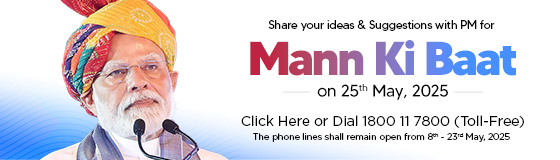
Inviting Ideas for Mann Ki Baat by Prime Minister Narendra Modi on 25th May 2025

Inviting Ideas for Mann Ki Baat by Prime Minister Narendra Modi on 25th May 2025
Start Date :
May 08, 2025
Last Date :
May 23, 2025
23:45 PM IST (GMT +5.30 Hrs)
Submission Closed

Hon'ble PM Narendra Modi looks forward to sharing his thoughts on themes and issues that matter to you. Prime Minister invites you to share your ideas on topics he should address ...

Hon'ble PM Narendra Modi looks forward to sharing his thoughts on themes and issues that matter to you. Prime Minister invites you to share your ideas on topics he should address on the 122nd Episode of Mann Ki Baat.

Send us your suggestions on the themes or issues you want the Prime Minister to speak about in the upcoming Mann Ki Baat episode. Share your views in this Open Forum or alternatively, you can also dial the toll-free number 1800-11-7800 and record your message for the Prime Minister in either Hindi or English. Some of the recorded messages may become part of the broadcast.

You can also give a missed call on 1922 and follow the link received in SMS to directly give your suggestions to the Prime Minister.

And stay tuned to Mann Ki Baat at 11:00 AM on 25th May 2025.

Reset
Showing 1934 Submission(s)
SANJAY SARKAR
SANJAY SARKAR 1 year 3 months ago
T Preface HE WAR IN KARGIL WILL GO DOWN IN THE HISTORY OF INDIA as a saga of unmatched bravery, grit and determination displayed on the battlefield by the Indian Army; a symbol of great pride and inspiration. The main credit for achieving success in Kargil undoubtedly goes to the units that fought on the front. Behind the blaze of their glory, not much seen but of cardinal importance, were the yeoman contributions of the multitude of agencies providing vital inputs such as combat support, communications and logistics. And finally, due recognition also needs to be given to those behind-the-scenes individuals whose responsibility was to draw up strategies, formulate battle plans and facilitate decisions. When a soldier goes out to perform his duty, he sublimates his individuality into that of his organization. He works in unison with his fellow-soldiers, trusting them completely. He strives to accomplish his mission whatever be the consequences – even if it means sacrifici
SANJAY SARKAR
SANJAY SARKAR 1 year 3 months ago
There may be remote chances of a full-scale conventional war between two nuclear weapon states but as long as there are territory-related disputes, the adversary can indulge in a proxy war or a limited border or conventional war. A major military challenge in India remains political reluctance to commit a proactive engagement. This invariably leads us to a reactive military situation. Also, no loss of territory is acceptable to the Indian public and political authority. To deal with such situations, it is essential to have credible strategic and tactical intelligence and assessments, effective surveillance and close defence of the lines of control. • Successful outcome of a border war depends on our ability to react rapidly in order to localize/freeze/reverse the military situation. The new strategic environment calls for speedier mobilization, versatile and flexible combat organizations and synergy amongst three services and other civil departments. • A conflict may rema
SANJAY SARKAR
SANJAY SARKAR 1 year 3 months ago
The Kargil War of 1999 saw Pakistani forces infiltrate Indian-administered Kashmir. India successfully counter-attacked, forcing Pakistani forces to withdraw and reclaiming the territory. India's larger army and advantageous geography gave it an edge in conventional warfare, while Pakistan relied more on unconventional tactics and nuclear threats. Today, both countries maintain a fragile "cold peace," facing the constant threat of further conflict
DR SWAPNIL MANTRI
DR SWAPNIL MANTRI 1 year 3 months ago
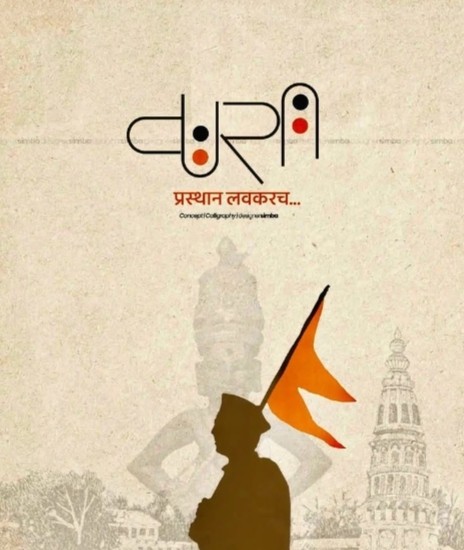
The Pandharpur Wari is a significant cultural and spiritual event in Maharashtra which is commencing on 20th June 2025. It holds importance for several reasons: 1. Spiritual Significance: The Wari is a pilgrimage to the sacred town of Pandharpur, dedicated to Lord Vitthala, a revered deity in Hinduism. 2. Cultural Heritage: The Wari showcases rich cultural traditions, including music, dance, and folk art, reflecting Maharashtra's vibrant heritage. 3. Community Bonding: The Wari brings people together, fostering a sense of community and social unity among devotees. 4. Spiritual Growth: The Wari is believed to promote spiritual growth, self-reflection, and devotion among participants. 5. Tradition and Legacy: The Wari has been a long-standing tradition, passed down through generations, preserving cultural and spiritual practices. The Pandharpur Wari is a celebration of faith, culture, and community, attracting devotees from across the region.
mygov_17468098591106017
SANJAY SARKAR
SANJAY SARKAR 1 year 3 months ago
“Terrorism is the war of the poor, and war is the terrorism of the rich.” — Peter Ustinov The world has seen countless rivalries, but few are as tense or as dangerous as the one between India and Pakistan. Both countries hold nuclear weapons. Both carry decades of bitter history. And both have the kind of mistrust that can turn sparks into wildfires. Just a few days ago, a brutal terror attack shook Kashmir, leaving innocent tourists dead and reopening old wounds that never truly healed.
SANJAY SARKAR
SANJAY SARKAR 1 year 3 months ago
The last major conflict, the 1999 Kargil War, saw Pakistani soldiers secretly crossing into Indian territory, but India fought back hard and regained its land. Over time, one thing became clear: India’s bigger army and geography gave it an edge in conventional wars, while Pakistan leaned more on guerrilla tactics and nuclear threats. Today, the two countries live under a tense “cold peace,” always just one step away from another clash. Military Strength Comparison
SANJAY SARKAR
SANJAY SARKAR 1 year 3 months ago
India and Pakistan have fought four major wars since they split apart in 1947, and every fight left deep scars. The first war (1947–48) was over Kashmir and ended in a stalemate, setting up today’s Line of Control. In 1965, Pakistan tried to sneak forces into Kashmir, leading to weeks of heavy fighting. Both sides claimed victory, but nothing much changed on the ground. In 1971, the focus shifted to East Pakistan (now Bangladesh). After a brutal civil war, India helped Bangladesh win independence, and Pakistan faced a crushing defeat, with 93,000 troops surrendering.
SANJAY SARKAR
SANJAY SARKAR 1 year 3 months ago
If you’re wondering what would happen if these two neighbors ended up in a war today, you’re not alone. Let’s walk through it together, from the scars of past conflicts to who holds the upper hand today, and why the stakes are higher now than ever before. Grab a cup of chai (or coffee) as this isn’t just a story of armies and weapons, but a story that could shape the future of an entire region.
SANJAY SARKAR
SANJAY SARKAR 1 year 3 months ago
Generations of Indians have never experienced war and are now being trained for emergency situations. But they have seen a period of steady and clear economic deceleration that has left the country with gaping income inequality, our widest ever. If Israel is the model for military aggression, then the financial cost of that level of armed conflict must also be reckoned with. Because just as wildfires can either be contained or spread with fury, the fires that burn near communities can become dangerous and even deadly if they grow out of control.
SANJAY SARKAR
SANJAY SARKAR 1 year 3 months ago
Conflicts also divert resources from developmental projects to defence spending. In the coming weeks, the questions that Finance and Defence Ministries should jointly be assessing are: first, what is the cost of military preparations that preclude war, and how fit for purpose are India’s conventional and non-conventional military forces? Second, what is the long-term cost to growth in a fragile economic period where countries across the world are facing an exceptional level of policy and trade whiplashes—geopolitical tensions will be a potentially lethal mix to this cocktail of uncertainty. And third, what could costs escalate to, in the event of a powerful third party entering this hostility between two nations?