
Home | MyGov

Accessibility
Accessibility Tools
Color Adjustment
Text Size
Navigation Adjustment
Screen Reader iconScreen Reader

Inviting Ideas for Mann Ki Baat by Prime Minister Narendra Modi on 25th May 2025

Inviting Ideas for Mann Ki Baat by Prime Minister Narendra Modi on 25th May 2025
Start Date :
May 08, 2025
Last Date :
May 23, 2025
23:45 PM IST (GMT +5.30 Hrs)
Submission Closed

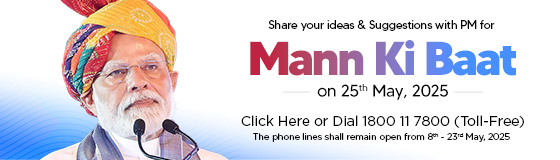
Hon'ble PM Narendra Modi looks forward to sharing his thoughts on themes and issues that matter to you. Prime Minister invites you to share your ideas on topics he should address ...

Hon'ble PM Narendra Modi looks forward to sharing his thoughts on themes and issues that matter to you. Prime Minister invites you to share your ideas on topics he should address on the 122nd Episode of Mann Ki Baat.

Send us your suggestions on the themes or issues you want the Prime Minister to speak about in the upcoming Mann Ki Baat episode. Share your views in this Open Forum or alternatively, you can also dial the toll-free number 1800-11-7800 and record your message for the Prime Minister in either Hindi or English. Some of the recorded messages may become part of the broadcast.

You can also give a missed call on 1922 and follow the link received in SMS to directly give your suggestions to the Prime Minister.

And stay tuned to Mann Ki Baat at 11:00 AM on 25th May 2025.

Reset
Showing 1934 Submission(s)
SANJAY SARKAR
SANJAY SARKAR 1 year 3 months ago
Sheikh Mujibur Rahman, a prominent leader in East Pakistan, founded the Awami League and began advocating for greater autonomy. He introduced the Six-Point Programme, which demanded significant autonomy for East Pakistan. The West Pakistani leadership rejected the demands, accusing Mujibur Rahman of promoting secession.  He was arrested but later released due to lack of evidence, which increased his popularity and widened the rift between East and West Pakistan. 1970: General Elections
SANJAY SARKAR
SANJAY SARKAR 1 year 3 months ago
Linguistic and Cultural Differences The government of West Pakistan imposed Urdu as the national language, ignoring the Bengali-speaking majority in East Pakistan. East Pakistanis, who had a distinct culture and were considered closer to India and Hindu traditions, faced discrimination from West Pakistani leaders. Former Pakistani President Ayub Khan, in his book Friends Not Masters (1967), remarked on the “Hindu cultural and linguistic influence” on East Pakistanis, further highlighting the divide.
SANJAY SARKAR
SANJAY SARKAR 1 year 3 months ago
India needs to look at more ways to deepen its ties with Bangladesh, especially keeping in mind the shifting nature of geopolitics and geoeconomics in South Asia. India and Bangladesh have more or less agreed on most issues and this stability must be maintained. India needs to find a fine balance in respecting Bangladesh’s economic growth while maintaining its economic progress.
SANJAY SARKAR
SANJAY SARKAR 1 year 3 months ago
opportunities in the country due to their growth potential. Bangladesh is crucial for India’s connectivity and peace in the north-eastern states. India had recently inaugurated the new trade corridor, Maitri Setu Bridge from Sabroom in India to Ramgargh in Bangladesh on the Feni river in Tripura-Bangladesh border. Bangabandhu Mujibur Rahman was awarded the Gandhi Peace Prize 2021. Bangladesh was a special invitee to India’s 75th independence day celebrations and President Kovind is part of Victory day celebrations in Bangladesh. Bangladesh marked 50 years of liberation war victory over Pakistan on 16th December 2021. The nation celebrated victory in the 1971 war for independence by hosting a military parade with India’s president as a guest of honour. Bangladesh has a special place in India’s neighbourhood first policy and the relation is ever more crucial in the current geopolitical scenario as well.
SANJAY SARKAR
SANJAY SARKAR 1 year 3 months ago
This could lead to the side-lining of the pro-India Awami League and shift the leadership of the movement to left-wing pro-China parties such as the Bhashani-led National Awami Party and the Communist Party. Negating Internal Security Threat: The Guerrilla warfare, inspired by Maoist ideology, was the major form of resistance against the Pakistani military. If India wouldn’t have intervened in the Bangladesh Liberation War 197, this could have been detrimental for India’s internal security interests, especially in the context of the Naxalite movement which was then raging in eastern India. Negating The Communal Threat: By July-August 1971, 90% of the refugees were Hindus concentrated in the border districts of West Bengal with large Muslim populations. Consequently, there was danger of serious communal strife if India did not act quickly to ensure their return. Departure from Non-Alignment: At the diplomatic level, India did not act entirely alone. Prime Minister Indira Gandhi’s c
SANJAY SARKAR
SANJAY SARKAR 1 year 3 months ago
How did the Indo Pak War 1971 shape today’s India-Bangladesh relations- The Indo-Pak war of 1971 liberated Bangladesh and established a friendly neighbourhood on the eastern front for India. Bangladesh is India’s largest trading partner in South Asia and one of the fastest-growing economies. Indian firms have huge investment opportunities in the country due to their growth potential. Bangladesh is crucial for India’s connectivity and peace in the north-eastern states. India had recently inaugurated the new trade corridor, Maitri Setu Bridge from Sabroom in India to Ramgargh in Bangladesh on the Feni river in Tripura-Bangladesh border. Bangabandhu Mujibur Rahman was awarded the Gandhi Peace Prize 2021. Bangladesh was a special invitee to India’s 75th independence day celebrations and President Kovind is part of Victory day celebrations in Bangladesh.
SANJAY SARKAR
SANJAY SARKAR 1 year 3 months ago
Bangladesh Liberation war changed the political landscape of South Asia in following ways, Diminishing the Two-front War Threat: The East Pakistan uprising provided India with the opportunity to break up Pakistan and eliminate the threat of a two-front war in any future confrontation. Although the eastern front remained largely inactive in 1965, it tied down substantial military resources that could have been deployed to greater effect in the western theatre. Preventing Side-Lining of Pro-India Awami League: India recognised that a drawn-out civil war in East Pakistan would radicalise the Bengali population. This could lead to the side-lining of the pro-India Awami League and shift the leadership of the movement to left-wing pro-China parties such as the Bhashani-led National Awami Party and the Communist Party. Negating Internal Security Threat: The Guerrilla warfare, inspired by Maoist ideology, was the major form of resistance against the Pakistani military. If India wouldn’t
SANJAY SARKAR
SANJAY SARKAR 1 year 3 months ago
This could lead to the side-lining of the pro-India Awami League and shift the leadership of the movement to left-wing pro-China parties such as the Bhashani-led National Awami Party and the Communist Party. Negating Internal Security Threat: The Guerrilla warfare, inspired by Maoist ideology, was the major form of resistance against the Pakistani military. If India wouldn’t have intervened in the Bangladesh Liberation War 197, this could have been detrimental for India’s internal security interests, especially in the context of the Naxalite movement which was then raging in eastern India. Negating The Communal Threat: By July-August 1971, 90% of the refugees were Hindus concentrated in the border districts of West Bengal with large Muslim populations. Consequently, there was danger of serious communal strife if India did not act quickly to ensure their return. Departure from Non-Alignment: At the diplomatic level, India did not act entirely alone. Prime Minister Indira Gandhi’s c
SANJAY SARKAR
SANJAY SARKAR 1 year 3 months ago
1971 war was fought for independence of Bangladesh from Pakistan. Indian armed forces supported Bangladesh in its liberation war. Pakistan had to suffer huge defeat and about 93000 Pakistani troops surrendered to Indian armed forces. Body – Bangladesh Liberation war changed the political landscape of South Asia in following ways, Diminishing the 
SANJAY SARKAR
SANJAY SARKAR 1 year 3 months ago
Diminishing the Two-front War Threat: The East Pakistan uprising provided India with the opportunity to break up Pakistan and eliminate the threat of a two-front war in any future confrontation. Although the eastern front remained largely inactive in 1965, it tied down substantial military resources that could have been deployed to greater effect in the western theatre. Preventing Side-Lining of Pro-India Awami League: India recognised that a drawn-out civil war in East Pakistan would radicalise the Bengali population. This could lead to the side-lining of the pro-India Awami League and shift the leadership of the movement to left-wing pro-China parties such as the Bhashani-led National Awami Party and the Communist Party. Negating Internal Security Threat: The Guerrilla warfare, inspired by Maoist ideology, was the major form of resistance against the Pakistani military.