
Home | MyGov

Accessibility
Accessibility Tools
Color Adjustment
Text Size
Navigation Adjustment
Screen Reader iconScreen Reader

Inviting Ideas for Mann Ki Baat by Prime Minister Narendra Modi on 25th May 2025

Inviting Ideas for Mann Ki Baat by Prime Minister Narendra Modi on 25th May 2025
Start Date :
May 08, 2025
Last Date :
May 23, 2025
23:45 PM IST (GMT +5.30 Hrs)
Submission Closed

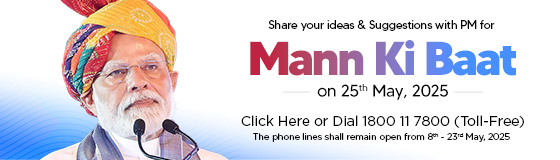
Hon'ble PM Narendra Modi looks forward to sharing his thoughts on themes and issues that matter to you. Prime Minister invites you to share your ideas on topics he should address ...

Hon'ble PM Narendra Modi looks forward to sharing his thoughts on themes and issues that matter to you. Prime Minister invites you to share your ideas on topics he should address on the 122nd Episode of Mann Ki Baat.

Send us your suggestions on the themes or issues you want the Prime Minister to speak about in the upcoming Mann Ki Baat episode. Share your views in this Open Forum or alternatively, you can also dial the toll-free number 1800-11-7800 and record your message for the Prime Minister in either Hindi or English. Some of the recorded messages may become part of the broadcast.

You can also give a missed call on 1922 and follow the link received in SMS to directly give your suggestions to the Prime Minister.

And stay tuned to Mann Ki Baat at 11:00 AM on 25th May 2025.

Reset
Showing 1934 Submission(s)
SANJAY SARKAR
SANJAY SARKAR 1 year 3 months ago
Mutual cooperation Mutual cooperation between Indian armies and Bangladeshi local population in the East Pakistan making it difficult for Pakistani armies to survive there. Friendship treaty To secure itself against a possible U.S.-China intervention in case events led to war, India signed on August 9 a 20-year Indo-Soviet Treaty of Peace, Friendship and Cooperation.
SANJAY SARKAR
SANJAY SARKAR 1 year 3 months ago
India played the great role in emergence of independent Bangladesh and was the first country to recognise Bangladesh as separate state. India’s humanitarian intervention in Bangladesh has shaped South Asia, made it a responsible power in the region. India’s links with Bangladesh are civilisational, cultural, social and economic. The shared colonial legacy, history and socio-cultural bonds demand that the political leadership of the two countries inject momentum into India-Bangladesh relations.
SANJAY SARKAR
SANJAY SARKAR 1 year 3 months ago
Mutual cooperation Mutual cooperation between Indian armies and Bangladeshi local population in the East Pakistan making it difficult for Pakistani armies to survive there. Friendship treaty To secure itself against a possible U.S.-China intervention in case events led to war, India signed on August 9 a 20-year Indo-Soviet Treaty of Peace, Friendship and Cooperation.
SANJAY SARKAR
SANJAY SARKAR 1 year 3 months ago
General Ayub Khan took over Pakistan in 1958, the East Pakistan’s needs and demands were completely suppressed. Until 1962, martial law continued and Ayub purged a number of politicians and civil servants from the government and replaced them with army officers. Distance factor: Pakistan couldn’t tackle the strange phenomenon of being divided by a thousand miles of India. Six-Point Program discarded: The six point program of Mujib-Ur-Rahman in 1966 for economic and political autonomy of East Pakistan was discarded.
SANJAY SARKAR
SANJAY SARKAR 1 year 3 months ago
India chose to fight against Pakistan in the winter months when the Himalayan passes were snowbound thus cutting China’s military support to Pakistan. Decisive Leadership Indira Gandhi had been a hawkish leader known for her firm decisions. Her stand didn’t collapse even under US pressure by 7th Fleet Naval mobilization threat. Astute Diplomacy The then Prime minister Indira Gandhi sought international opinion to the cause of Bangladesh and made aware of India’s unbearable burden of refugees. She build a consensus to force a UN resolution condemning the Pakistani atrocities in Bangladesh
SANJAY SARKAR
SANJAY SARKAR 1 year 3 months ago
Immediate Cause: The Awami League, led by Sheikh Mujibur Rahman, won a landslide victory in the national elections in 1971 and demanded autonomy for East Pakistan. This victory also gave it the right to form a government, but Zulfikar Ali Bhutto, the Chairman of the Pakistan People’s Party refused to let the Sheikh become the Prime Minister of Pakistan. This initiated the war.
SANJAY SARKAR
SANJAY SARKAR 1 year 3 months ago
Six-Point Program discarded: The six point program of Mujib-Ur-Rahman in 1966 for economic and political autonomy of East Pakistan was discarded. Imposition of Urdu: Urdu was made the “National Language” of Pakistan. The requests from East Pakistan and option of Arabic were turned down. Genocides and Refugee Problems: There was a systematic ethnic slaughter which qualified as genocide. There was clear ethnic or religious targeting of the Hindu minority among the Bengalis. By July-August 1971, 90% of the refugees were Hindus concentrated in the border districts of West Bengal with large Muslim populations.
SANJAY SARKAR
SANJAY SARKAR 1 year 3 months ago
The Indo-Pak War of 1965 was a culmination of skirmishes that took place between April 1965 and September 1965 between Pakistan and India. The conflict began following Pakistan’s Operation Gibraltar, which was designed to infiltrate forces into Jammu and Kashmir to precipitate an insurgency against India who retaliated by launching a full-scale military attack on West Pakistan. The seventeen-day war resulted in India taking a decisive edge over Pakistani war machinery. The conflict ended with the subsequent issuance of the Tashkent Declaration. The 1971 war saw the Indian Army defeating the Pakistani army and taking in around 93,000 Pakistani prisoners while ensuring 75 million people of Bangladesh their independence. The war started when Pakistan launched air strikes on 11 Indian airbases. It was for the first time in which India’s all three forces fought in unison on both western
SANJAY SARKAR
SANJAY SARKAR 1 year 3 months ago
Economic Prowess of East Pakistan: Most of the foreign exchange was earned by exports from East Pakistan which was poorly defended when the big war of 1965 with India was fought. Disparity of Governance: Punjab and the Punjabi-dominated army ruled Pakistan soon after the birth of Pakistan. The services were also dominated by Punjabis through quotas but East Pakistan dominated in literacy and high education. Top seats in the civil services exams always went to East Pakistan.
SANJAY SARKAR
SANJAY SARKAR 1 year 3 months ago
Language controversy In 1948, Jinnah declared that Urdu will the official language and the people of East Pakistan who were bangle speaking, will have to comply. This led to widespread protests in East Pakistan and the “Language Movement” began for the right of Bengalis to use Bangla as their official language. This movement was led by Sheikh Mujibur Rehman, who joined the Awami League party. The struggle against the Muslim league’s Urdu imposition continued till the 1960s.