Home | MyGov

Accessibility
Accessibility Tools
Color Adjustment
Text Size
Navigation Adjustment
Screen Reader iconScreen Reader

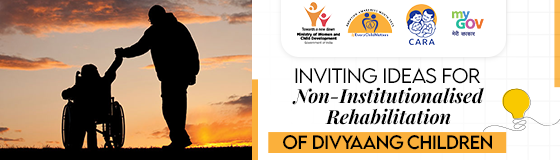
Inviting Ideas for Non-Institutionalised Rehabilitation of Divyaang Children

Inviting Ideas for Non-Institutionalised Rehabilitation of Divyaang Children
Start Date :
Oct 01, 2025
Last Date :
Nov 30, 2025
17:30 PM IST (GMT +5.30 Hrs)
Submission Closed

In 2025, the Central Adoption Resource Authority (CARA) is placing special focus on promoting family-based care for children with special needs (Divyaang children). In ...

In 2025, the Central Adoption Resource Authority (CARA) is placing special focus on promoting family-based care for children with special needs (Divyaang children). In collaboration with MyGov, CARA invites all Indian citizens to participate in an important national discussion on the theme:
“Non-institutionalized Rehabilitation of Children with Special Needs (Divyaang Children)”

This initiative seeks to create a collaborative platform where citizens can:
1. Share insights on the challenges and barriers in the identification and adoption of children with special needs
2. Suggest innovative ideas, strategies, or solutions to strengthen the adoption ecosystem
3. Contribute to policy-making by offering actionable recommendations to ensure a loving family environment for every child, especially those currently residing in Specialized Adoption Agencies (SAAs) and Child Care Institutions (CCIs)

Your thoughtful suggestions can play a key role in shaping a more inclusive, compassionate, and efficient adoption framework for Divyaang children.

Who can participate?
All Indian citizens are welcome to join the conversation and submit their ideas.

Why participate?
Selected entries may be featured in national-level publications, exhibitions, and even considered in policy discussions aimed at improving the lives of children with special needs.

Let’s work together to ensure every child finds a loving family and a brighter future. Join the discussion today and be a voice for change!

Reset
Showing 777 Submission(s)
GARAIYA AKSHAY
GARAIYA AKSHAY 1 year 2 weeks ago
Non-institutionalized rehabilitation focuses on integrating therapies, education, and daily living skills within home or community settings, allowing Divyaang children to build natural bonds and achieve personalized milestones. Unlike rigid institutional routines, these models encourage parental involvement and peer interactions, which research shows accelerate cognitive and physical progress. Citizens contributing to the platform might describe how foster care or sponsorship programs have transformed lives, highlighting the need for scalable resources like home-based therapy kits to bridge urban-rural gaps. Such exchanges can inspire local adaptations, making rehabilitation accessible and culturally attuned across diverse regions.
GARAIYA AKSHAY
GARAIYA AKSHAY 1 year 2 weeks ago
Stigma and cultural misconceptions pose significant hurdles, with many families viewing disabilities as a curse or source of shame, leading to concealment and delayed interventions in both urban and rural settings.
kumar shanu
kumar shanu 1 year 2 weeks ago
Thanks sir for considering divyang children . 1. we can train them based on skill india program and they can first try to earn some money and also we can pay little bit higher than normal people . so they can be self dependent because of various types of divyang in our society and they can also contribute to our growth.
BHUPENDRA KUMAR SEN
BHUPENDRA KUMAR SEN 1 year 2 weeks ago
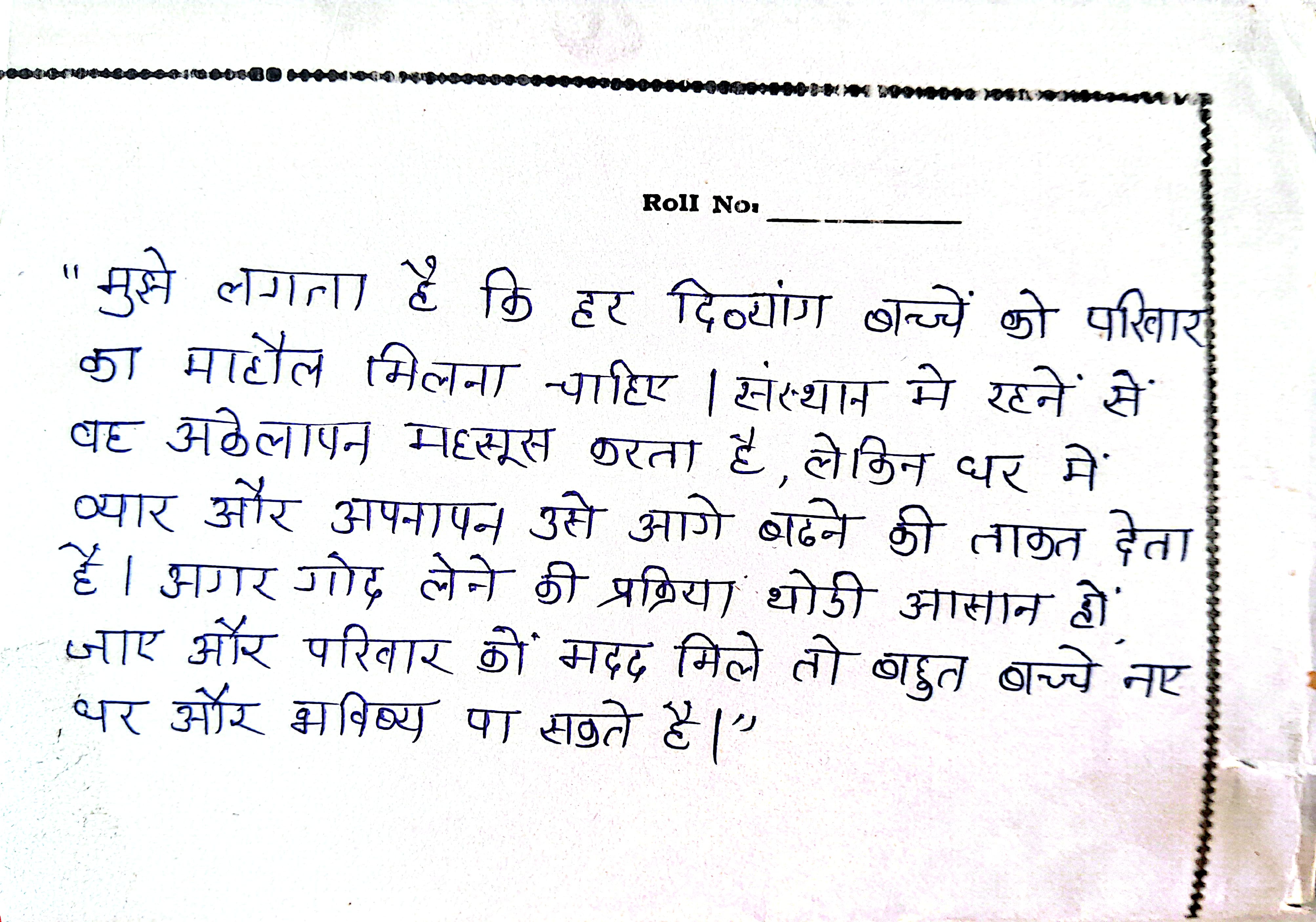
“मुझे लगता है कि हर दिव्यांग बच्चे को परिवार का माहौल मिलना चाहिए। संस्थान में रहने से वह अकेलापन महसूस करता है, लेकिन घर में प्यार और अपनापन उसे आगे बढ़ने की ताकत देता है। अगर गोद लेने की प्रक्रिया थोड़ी आसान हो जाए और परिवारों को मदद मिले तो बहुत बच्चे नए घर और भविष्य पा सकते हैं।”
mygov_1759672555104761791
Akula ramanjaneyulu
Akula ramanjaneyulu 1 year 2 weeks ago
Respected honourable prime minister sir I A.Ramnjaneyulu junior lecturer in economics namaste request you that please accept my ideas about the uplifting the divyang children. 1.HOME BASED EDUCATION:PROVIDES EDUCATIONAL SUPPORT AND RESOURCES FOR CHILDREN WITH DISABILITIES IN THEIR OWN HOMES. 2.VOCATIONAL TRAINING IN SKILLS LIKE CRAFTS,COOKING OR GARDENING. 3.PLAY GROUPS:ORGANIZE PLAY GROUPS FOR CHILDREN WITH DISABILITIES TO INTERACT WITH PEERS. 4.ASSISTIVE TECHNOLOGY:PROVIDE ACCESS TO ASSISTIVE DEVICES SUCH AS WHEELCHAIRS,PROSTHETICS,OR COMMUNICATION AIDS. 5.OFFERING COUNCELLING AND EMOTIONAL SUPPORT FOR FAMILIES.
mygov_1759663165123175861
mygov_1759663182123175861
mygov_1759663204123175861
Dhananjay Pratap Singh
Dhananjay Pratap Singh 1 year 2 weeks ago
सफल परिवारों और दिव्यांग युवाओं को ब्रांड एम्बेसडर बनाया जाए, ताकि वे समाज में प्रेरणा और सकारात्मक दृष्टिकोण फैलाएँ।