Home | MyGov

Accessibility
Accessibility Tools
Color Adjustment
Text Size
Navigation Adjustment
Screen Reader iconScreen Reader

Manodarpan: Inviting ideas to combat Psycho-social stress on School and College Students, Teachers and Parents due to COVID-19 pandemic

Start Date :
Jul 21, 2020
Last Date :
Aug 21, 2020
23:45 PM IST (GMT +5.30 Hrs)
Submission Closed

The outbreak of the global pandemic COVID -19 presents a challenging time for everyone around the world. Not only is this pandemic a serious medical concern, but it also brings ...

The outbreak of the global pandemic COVID -19 presents a challenging time for everyone around the world. Not only is this pandemic a serious medical concern, but it also brings mixed emotions and psycho-social stressors for all. There are emerging mental health concerns with specific focus on Children, Adolescents and Youth as they more vulnerable to heightened level of stress, anxiety and fearfulness, along with a range of other emotional and behavioral issues. COVID-19 has also brought new stressors on Teachers and Parents hampering their capacity to provide positive support to their wards. While it is important to focus on continuing education on the academic front, we must give equal importance to the mental health and well-being of the students.

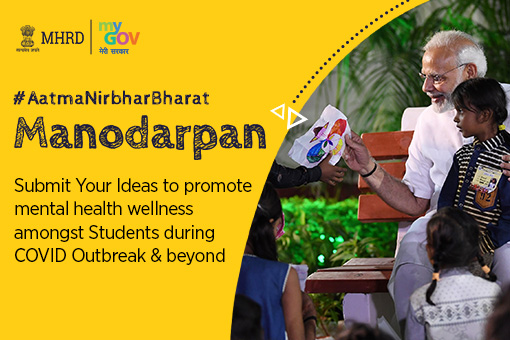
Manodarpan, an initiative of the Ministry of Human Resource Development, Government of India, under the AatmaNirbhar Bharat Abhiyan, aims at mobilizing psycho-social support to help Children, Youth, Teachers and Parents country-wide in a comprehensive and multimodal manner during conditions like COVID-19 and after. For more information, please visit www.mhrd.gov.in/covid-19/

MyGov in collaboration with the Ministry of Human Resource Development, Government of India, hereby invites citizens to share ideas and inputs to combat the psycho-social stress on School & College Students, Teachers and Parents, caused due to COVID-19 pandemic. Selected comments may be featured on social media.

Last date of sending us your inputs is 21st August 2020

Reset
Showing 3814 Submission(s)
Dr Guinness Madasamy
Dr Guinness Madasamy 6 years 3 weeks ago
Occupation was found to be the main determinant for how the crisis has affected young women and men in employment differently, with young women reporting greater losses in productivity as compared to young men.
Dr Guinness Madasamy
Dr Guinness Madasamy 6 years 3 weeks ago
Young people in lower-income countries(like India) are the most exposed to reductions in working hours and the contraction in income that results.
Dr Guinness Madasamy
Dr Guinness Madasamy 6 years 3 weeks ago
Working hours among employed youth fell by nearly a quarter (i.e. by an average of two hours a day) and two out of five young people (42 per cent) reported a reduction in their income
ARUN KUMAR GUPTA
ARUN KUMAR GUPTA 6 years 3 weeks ago
We have many challenges in making India #AatmaNirbhar. One of them is our environmental laws and it's implementation. Many items which we were manufacturing in India and we can manufacture in India are being imported because no one wants to manufacture because of environmental laws. Environmental laws are to ensure development of country while ensuring protection of the environment. If the factories are closed how can we become AatmaNirbhar. How can we create jobs for crores of young population
Dr Guinness Madasamy
Dr Guinness Madasamy 6 years 3 weeks ago
One in six young people (17 per cent) who were employed before the outbreak, stopped working altogether, most notably younger workers aged 18–24, and those in clerical support, services, sales, and crafts and related trades
Dr Guinness Madasamy
Dr Guinness Madasamy 6 years 3 weeks ago
The pandemic is also inflicting a heavy toll on young workers, destroying their employment and undermining their career prospects
Dr Guinness Madasamy
Dr Guinness Madasamy 6 years 3 weeks ago
Despite the best efforts of schools and training institutions to provide continuity through online delivery, 65 per cent of young people reported having learnt less since the pandemic began, 51 per cent believe their education will be delayed, and nine per cent feared their education would suffer and might even fail.
Dr Guinness Madasamy
Dr Guinness Madasamy 6 years 3 weeks ago
a situation particularly acute among youth in lower-income countries and one that serves to underline the sharp digital divides that exist between regions
Dr Guinness Madasamy
Dr Guinness Madasamy 6 years 3 weeks ago
Of the young people who were either studying or combining study and work before the onset of the crisis, three-quarters (73 per cent) experienced school closures, yet not all were able to transition into online and distance learning