
Home | MyGov

Accessibility
Accessibility Tools
Color Adjustment
Text Size
Navigation Adjustment
Screen Reader iconScreen Reader

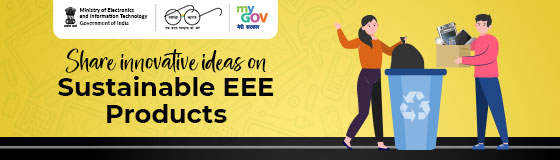
Share innovative ideas on sustainable EEE Products

Share innovative ideas on sustainable EEE (Electrical and Electronic Equipment) Products
Start Date :
Feb 01, 2022
Last Date :
Feb 15, 2022
23:45 PM IST (GMT +5.30 Hrs)
Submission Closed

Share innovative ideas on sustainable EEE Products ...

Share innovative ideas on sustainable EEE Products

Electrical and Electronic Equipment ( EEE ) and materials are one of the biggest challenges to sustainability. EEE are responsible for highly complex waste generation, energy-intensive manufacturing, usage and waste processing.

Ministry of Electronics & Information Technology (MeitY) observes Swachhata Pakhwada 2022 from 1st February 2022 to 15th February 2022 promoting ‘E-waste se Raksha- Swachhata hi Suraksha’. Citizens are invited to share their ideas on how EEE products and materials can be made more sustainable.

We value your suggestions which would be instrumental in encouraging efforts towards sustainable practices in Electrical and Electronic products and spreading the awareness about same.

The best entries from the citizens will be identified by the Ministry and will be featured on the MyGov page.

The last date to receive suggestions is 15th February 2022.

Reset
Showing 361 Submission(s)
Krishan Gopal Maheshwari
Krishan Gopal Maheshwari 4 years 4 months ago
1) Introduce Indian Environmental Protection Agency(IEPA) which will provide 2 certification (Responsible Reuse-Recycle Practice & Standard Product Stewardship)for guaranteeing the professional handling of E waste. 2) Launch initiative where people repair products themselves using free internet platform stepwise instructions e.g ifixit.com 3) Raise awareness by 1 minute film competition with theme like recycle old mobile phones. 4)Give second life to products using remanufacturing/refurbishment of used ones. 5) Have SAARC/Asia Science Hub for sustainable development. 6)Apply detoxification principle using green/sustainable chemistry & process of chemical substitution.E.G.Use of Totally Chlorine free(TCF) bleaching technology, Use of Hydro fluoroalkanes like HFA-134a as propellants, Use of aqueous solvents in paints etc. 7) Apply dematerialisation strategies like replacing product with service & material substitution to preserve natural capital. 8) Have Whistleblower protection laws.
PavneshSharma
PavneshSharma 4 years 4 months ago
EEE Products and Materials is daily increasing in Tones. Which will be a great challenge to handle as well as Environment point of view. It can be make a rule that No new EEE Product can be purchased until old EEE Product is returned to Dealer, This way it will be collected centrally by Dealers/ Sellers which will be Reused / Recycled and it will be made more sustainable. Thanks
Anindita Das
Anindita Das 4 years 4 months ago
At first I would like to say that the efforts of all the citizens together can make a change . 1) First we have to promote and spread awareness of sustainable products to a large number of people 2) At every big or medium cities plastic recycling units can be opened to make something good out of it which many people consider as a waste. 3) Giving importance to small businesses which produces susitainable products. 4) Opening up of units that make eco-friendly or susitainable color paints which are used to paint idols
KASHINATH BASAPPA UDNUR
KASHINATH BASAPPA UDNUR 4 years 4 months ago
The waste of EEE shall be used as craft and decorative items like photo frames,teapoys,wall hangings, flower pots,pen stands and so on. A craft training school be opened to reuse theses wastes.
SUTHAHAR P
SUTHAHAR P 4 years 4 months ago
“Sustainable development satisfies the needs of the present generation, without endangering the possibilities of future generations to meet their own needs.” Since 1987, this United Nations definition has characterised the discussion about the terms sustainability and sustainable development. Sustainability describes the ability of a community, organisation or a company to operate in such a way that they also have the capacity to endure into the future. This does not only apply to every individual and every company, but also for humanity as a whole. In the long-term, the current global community cannot live at the expense of future generations. This also includes individual communities not being allowed to consume in such a way that they burden people in other regions of the world.
Krishan Gopal Maheshwari
Krishan Gopal Maheshwari 4 years 4 months ago
1) Develop & Refined National Waste Policy (NWP) with Dept of Environment to administer free collection & recycling services from household & businesses. Establish good Indian Standard for e-waste recycling & implement with in this policy. Provide a Guide or Factsheet for household with essential information & with access to free door to door recycling services. 2)Run a scheme under NWP that companies or traders or marketing Co. produce or import EE products will be required to pay for & arrange collection & end of life (EOL) recycling their products. Such schemes has to be funded & run by industry. Household & small businesses need not to pay any fees or charges at the time of disposal and scheduled or rescheduled timings. This is like product stewardship where producers takes responsibility from creation to disposal. 3) Introduce replacement of CRT screen with LCD ( Pb elimination but Hg introduction). 4) Introduce less costly rechargeable batteries (Reduce Ni, Cd & increase Li)
SUTHAHAR P
SUTHAHAR P 4 years 4 months ago
Innovations and new product ideas should be communicated to the market at an early stage, as the customer initially should be convinced of the value of the new products. Customers do not buy innovative products merely because they are new. Novelty alone is not a selling point. The majority of customers are rather critical regarding new technologies. The balance is quite delicate, as products or services should not be considered to be too radically different so that potential customers don’t see its uses, whilst they should provide more utility than previous alternatives.
SUTHAHAR P
SUTHAHAR P 4 years 4 months ago
The success of a product is strongly dependent on the willingness of the users/customers to provide information. Companies learn what is wanted and required directly from their end-customers and local retailers. This information should subsequently be incorporated into the product development.