- Chandigarh UT
- Creative Corner
- Dadra Nagar Haveli UT
- Daman and Diu U.T.
- Department of Administrative Reforms and Public Grievances
- Department of Biotechnology
- Department of Commerce
- Department of Consumer Affairs
- Department of Industrial Policy and Promotion (DIPP)
- Department of Posts
- Department of Science and Technology
- Department of Telecom
- Digital India
- Economic Affairs
- Ek Bharat Shreshtha Bharat
- Energy Conservation
- Expenditure Management Commission
- Food Security
- Gandhi@150
- Girl Child Education
- Government Advertisements
- Green India
- Incredible India!
- India Textiles
- Indian Railways
- Indian Space Research Organisation - ISRO
- Job Creation
- LiFE-21 Day Challenge
- Mann Ki Baat
- Manual Scavenging-Free India
- Ministry for Development of North Eastern Region
- Ministry of Agriculture and Farmers Welfare
- Ministry of Chemicals and Fertilizers
- Ministry of Civil Aviation
- Ministry of Coal
- Ministry of Corporate Affairs
- Ministry of Culture
- Ministry of Defence
- Ministry of Earth Sciences
- Ministry of Education
- Ministry of Electronics and Information Technology
- Ministry of Environment, Forest and Climate Change
- Ministry of External Affairs
- Ministry of Finance
- Ministry of Health and Family Welfare
- Ministry of Home Affairs
- Ministry of Housing and Urban Affairs
- Ministry of Information and Broadcasting
- Ministry of Jal Shakti
- Ministry of Law and Justice
- Ministry of Micro, Small and Medium Enterprises (MSME)
- Ministry of Petroleum and Natural Gas
- Ministry of Power
- Ministry of Social Justice and Empowerment
- Ministry of Statistics and Programme Implementation
- Ministry of Steel
- Ministry of Women and Child Development
- MyGov Move - Volunteer
- New Education Policy
- New India Championship
- NITI Aayog
- NRIs for India’s Growth
- Open Forum
- PM Live Events
- Revenue and GST
- Rural Development
- Saansad Adarsh Gram Yojana
- Sakriya Panchayat
- Skill Development
- Smart Cities
- Sporty India
- Swachh Bharat (Clean India)
- Tribal Development
- Watershed Management
- Youth for Nation-Building
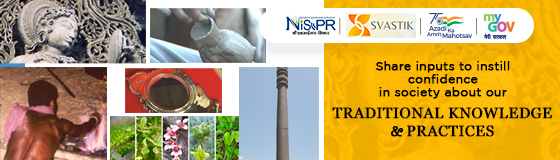
Share inputs to instil confidence in society about our traditional knowledge and practices

Start Date :
Mar 03, 2022
Last Date :
Aug 31, 2022
23:45 PM IST (GMT +5.30 Hrs)
India has a rich legacy of practices and knowledge touching different spheres of life and a scientific heritage traversing various Science & Technology (S&T) domains. The ...
All Comments
Featured
New Comments
Showing 2022 Submission(s)
Kota Srinivasa Reddy
4 years 1 month ago
Set up led screens explaining the culture and traditions of our country near famous shrines...
This is best option and it will to reach people early.
Om Namah Shivaya Namah...
Like
(14)
Dislike
(3)
Reply
Report Spam
priya
4 years 1 month ago
cadet Priya
khalsa College Amritsar
2pb naval unit Amritsar
mygov_1657960559109697821.pdf
Like
(12)
Dislike
(4)
Reply
Report Spam
Rahul
4 years 1 month ago
Film Industry is the main inspiration to our society, so use of Ayurveda, Yoga, Sanskrit language should be shown which will motivate common citizen. Ayurveda is evolved from one among the four vedas i.e Atharvaveda. Acharya Sushruta is considered Father of Surgery, also many Indian sages lived good quality of life for more than 500 years of life, where life now has low quality as well as quality.But if Daily Regimen, Night Regimen, Season wise Regimen, Achar Rasayana, Codes of Conduct, not to control urges are followed definitely we can prevent from lifestyle disorders and achieve good quality of life.
Like
(13)
Dislike
(3)
Reply
Report Spam
Farvez Basha D
4 years 1 month ago
Understanding the nature of social dynamics and how these structures emerge from a systems perspective is of great importance to social sustainability (Lv, 2018). Above all, in Gray (2010) and Guo’s (2017) views, social sustainability also encompasses many issues such as human rights, gender equity and equality, public participation and rule of law all of which promote peace and social stability for sustainable development.
Like
(10)
Dislike
(7)
Reply
Report Spam
Farvez Basha D
4 years 1 month ago
According to Kolk (2016) social sustainability is not about ensuring that everyone’s needs are met. Rather, its aims at providing enabling conditions for everyone to have the capacity to realize their needs, if they so desire. Anything that impedes this capacity is considered a barrier, and needs to be addressed in order for individuals, organization or community to make progress towards social sustainability (Brodhag & Taliere, 2006; Pierobon, 2019).
Like
(10)
Dislike
(7)
Reply
Report Spam
Farvez Basha D
4 years 1 month ago
In Saith’s (2006) opinion, at the social level sustainability entails fostering the development of people, communities and cultures to help achieve meaningful life, drawing on proper healthcare, education gender equality, peace and stability across the globe. It is argued (Benaim & Raftis, 2008) that social sustainability is not easy to achieve because the social dimension seems complicated and overwhelming. Unlike the environmental and economic systems where flows and cycles are easily observable, the dynamics within the social system are highly intangible and cannot be easily modelled (Benaim & Raftis, 2008; Saner, Yiu, & Nguyen, 2019). As Everest-Phillips (2014) puts it, “the definition of success within the social system is that “people are not subjected to conditions that undermine their capacity to meet their needs”
Like
(9)
Dislike
(7)
Reply
Report Spam
Farvez Basha D
4 years 1 month ago
However, in a more fundamental sense, “social sustainability” relates to the nexus between social conditions such as poverty and environmental destruction (Farazmand, 2016). In this regard, the theory of social sustainability’ posits that the alleviation of poverty should neither entail unwarranted environmental destruction nor economic instability. It should aim to alleviate poverty within the existing environmental and economic resource base of the society (Kumar, Raizada, & Biswas, 2014; Scopelliti et al., 2018).
Like
(9)
Dislike
(7)
Reply
Report Spam
Muthuselvam D
4 years 1 month ago
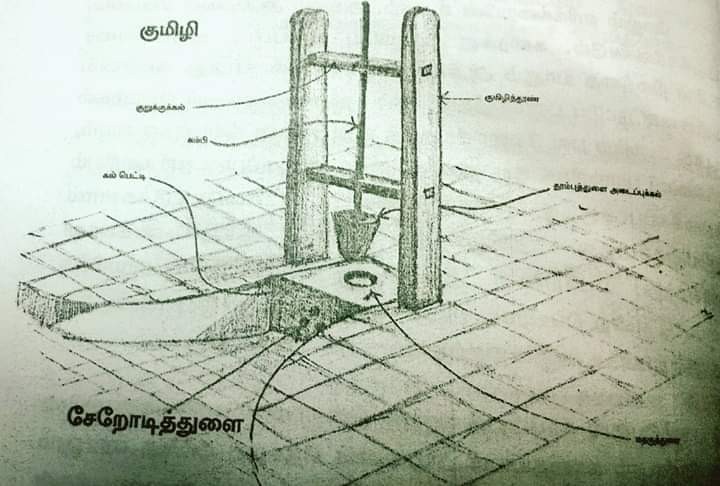
Kumizhi thumbu
A dam is a scientifically designed system to open the reservoirs of Tamil Nadu lakes for irrigation.It is designed like a cup to help drain out only the amount of water needed. There is a hole of half a foot in diameter at the top of this calabash. The name of this hole is Neerodi. This hole is covered with a stone like a pipe. There are two or three small holes at the floor level of the box and these are called mud holes. Below the ground level of the lake, a pipe system is laid so that the water flows through the hole in this kalpetti.
When water is needed for irrigation, the cobblestone in the hole is sunk into the water and taken out, then 80 percent of the water comes out through the stream hole of the lake and 20 percent of the water mixed with mud comes out through the mud. This reduces sedimentation in the lake. In some lakes, stone mandapams are erected to mark the location . We need to bring back our traditional water management system.
Like
(16)
Dislike
(3)
Reply
Report Spam
Vipin Kumar
4 years 1 month ago
Traditional knowledge refers to the knowledge and practices of indigenous and local communities that have developed over centuries and are traditionally transferred from elders to young people in concrete working and life situations. Traditional knowledge is dynamic and it can be transferred and expressed orally, through stories, legends, rituals, songs and laws. It can also be preserved in artifacts handed from father to son or mother to daughter.
Like
(15)
Dislike
(3)
Reply
Report Spam
Sanjeevi Bharadwaj Prabhanjan
4 years 1 month ago
Sir Make tradition Medicine part of education from class 1 to class 12 (Ayurveda, home medicine)
Like
(15)
Dislike
(3)
Reply
Report Spam
- View More