Home | MyGov

Accessibility
Accessibility Tools
Color Adjustment
Text Size
Navigation Adjustment
Screen Reader iconScreen Reader

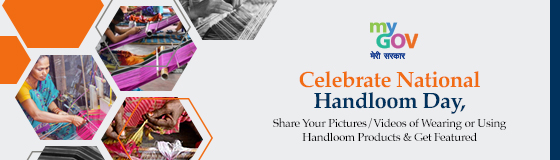
Share Your Pictures/Videos of Wearing or Using Handloom Products and Get Featured

Share Your Pictures/Videos of Wearing or Using Handloom Products and Get Featured
Start Date :
Jul 28, 2021
Last Date :
Aug 07, 2021
23:45 PM IST (GMT +5.30 Hrs)
Submission Closed

India’s Handloom sector is a symbol of our glorious cultural heritage and is an important source of livelihood in the country. ...

India’s Handloom sector is a symbol of our glorious cultural heritage and is an important source of livelihood in the country.

The first National Handloom Day was held on 7th August 2015 by Prime Minister Shri Narendra Modi. On this day, the handloom weaving community is honoured and their contribution to the socio-economic development of the country is highlighted, and the resolve to protect our handloom heritage and to empower the handloom weavers and workers with greater opportunities is reaffirmed.

Let us, together, ensure the sustainable development of the handloom sector by supporting our handloom weavers and workers for their exquisite craftsmanship.

As we approach National Handloom Day, we invite you to come forward & support the Handloom weavers/artists by sharing your photos or videos wearing or using Handloom products. The best pictures and videos will get featured at MyGov – the world’s biggest citizen engagement platform.

Go ahead, show your support to our glorious heritage!

Reset
Showing 893 Submission(s)
Prashant
Prashant 5 years 2 months ago
What is handloom? Be it Tamil Nadu’s famous Kanchipuram saris or Assam’s Muga (golden silk) mekhela sadors, the Paithani weaves of Maharashtra or Benarasi brocades of Uttar Pradesh, India has the largest and widespread weaving industry in the world. While different definitions for the word have evolved since the Handloom (Reservation and Articles for Production) Act, 1985, where ‘handloom’ meant “any loom other than powerloom”, in recent years it has become more elaborate. In 20
Prashant
Prashant 5 years 2 months ago
With the partition of Bengal, the Swadeshi Movement gained strength. It was on August 7, 1905 that a formal proclamation was made at the Calcutta Town Hall to boycott foreign goods and rely on Indian-made products. More than a century later, in 2015, Prime Minister Narendra Modi inaugurated the first National Handloom Day. It was a salute to weavers and others in the industry to promote the handmade and the handwoven
SandhyaraniDalai
SandhyaraniDalai 5 years 2 months ago
handloom products are necessary people's in Odisha . all Odisha people depending on handloom sarees ,salwar,kurta etc . we know handloom products mest be buy our out side country of india , so we must take part of develop our handloom products and organisations . THANKYOU
Nandhini
Nandhini 5 years 2 months ago
Even many modern design fabrics and clothes were coming in textile field... handloom products have its own position forever.... Gives the comfortable and rich look... because it's has made by the hardwork of the weavers. it's always special
mygov_162796747278489371
SHANMUGAM SELVAKUMAR
SHANMUGAM SELVAKUMAR 5 years 2 months ago
Some of the well-known Indian handloom saris are Kanchipuram silk saris, Maheshwari sari, Bagh print sari, Chanderi silk saris, Tussar silk sari, Banarasi silk sari, Baluchuri saris, Sambalpuri saris, Kantha stitch saris, Bhadhini saris and Munga saris.
SHANMUGAM SELVAKUMAR
SHANMUGAM SELVAKUMAR 5 years 2 months ago
Wearing handloom weaves is a simple and conscious way to leave a virtually-nil carbon footprint. Perfect for the Indian weather: Indian weaves are comfortable, breathable and easy on the skin—perfect for the largely tropical climate in India.
SHANMUGAM SELVAKUMAR
SHANMUGAM SELVAKUMAR 5 years 2 months ago
Generally speaking, handloom fabrics tend to be more expensive than the synthetic mill counterparts owing to the hand labour involved and limited production capacity when compared with power looms. Not all handlooms are expensive, and it totally depends on the fabrics or the yarns being used.