Home | MyGov

Accessibility
Accessibility Tools
Color Adjustment
Text Size
Navigation Adjustment
Screen Reader iconScreen Reader

Share your views on Rashtriya Avishkar Abhiyan

Share your views on Rashtriya Avishkar Abhiyan
Start Date :
Jul 26, 2015
Last Date :
Dec 30, 2015
00:00 AM IST (GMT +5.30 Hrs)
Submission Closed

The Ministry of Human Resource Development (MHRD) launched the Rashtriya Avishkar Abhiyan on 09.07.2015. Late Dr. A.P.J Abdul Kalam (former President of India) presided over the ...

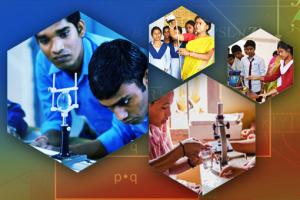
The Ministry of Human Resource Development (MHRD) launched the Rashtriya Avishkar Abhiyan on 09.07.2015. Late Dr. A.P.J Abdul Kalam (former President of India) presided over the function. The thrust of the Abhiyan is to provide support and a platform for schools to make Science, Mathematics and Technology exciting for children and encourage them to develop a natural curiosity interest and love towards learning Science and Mathematics, literally to “ignite their minds”.

One of the key highlights of the Abhiyan is the ‘Mentoring’ of schools and children through ‘Mentoring Institutions’ like IITs, NITs, Central Institutions, IISERs and Central State Universities and Colleges. Under the Abhiyan, the MHRD is also collaborating with Google in its ‘Code to Learn’ Contest where school students will be encouraged to develop Code using innovative software. Similarly, the Ministry is partnering with Intel for developing innovative technological capacities in girl students in Government schools.

In the first three years of the Abhiyan, it is expected that 25% of all Government schools will be covered by the ‘Mentoring Institutions’ through various activities and innovative strategies in partnership with the Department of Higher Education.

The Ministry invites ideas and suggestions from people on how the Abhiyan may creatively involve individuals to join the movement and to work directly work with school and school children to "ignite their minds".

Reset
Showing 2225 Submission(s)
Karm Singh Kamboj
Karm Singh Kamboj 11 years 1 week ago
New generation having interest in achieving more technical skill and it will be useful to introduce technical subject as part of study from school level
Rajesh Timane
Rajesh Timane 11 years 1 week ago
1) People in general can also contribute if given chance. 2) Let the public register with a school of their interest. 3) The schools can allot half an hour per day for selected 3-5 entries to present ideas. 4) These can be tried for week(s) based on number of people show interest. 5) Subject-wise Mentors can be chosen on the basis of their ability to IGNITE minds rather than their subject-knowledge.
RVR PRASAD
RVR PRASAD 11 years 1 week ago
This is continuation of my earlier contribution. Selecting an object for research, designing the methodology, observation, collecting data, reporting the findings etc have to be trained in simple terms to develop in them conceptual idea and methodical innovations
RVR PRASAD
RVR PRASAD 11 years 1 week ago
This is in continuation of my earlier comment. In the third group intelligent people identified in previous batches have to be selected for advanced leaning. They can be given special training by IITs etc. Hubs of Labs constructed by Government for a cluster of villages will be attended by these students and interested lecturers from nearby colleges during summer holidays. A software programme like the one launched by Australian Universities i.e. open2study is to be launched to provide inputs.
RVR PRASAD
RVR PRASAD 11 years 1 week ago
The students should be categorized into three age groups. Group I: 5-7 years; Group II: 8-13 years: Group III: 14-18 years. Curiosity can be developed in the first group by assigning tasks like assembling of simple toys. Providing illustrative books about how Issac Newton could think about gravitational force, James watt could discover power of steam etc. Intelligent students should be identified. In Group II teams have to be formed to undertake simple projects by explaining the methodology.
Reetesh Srivastava
Reetesh Srivastava 11 years 1 week ago
One of the key reasons for young minds unable to understand science is the lack of good books in vernacular languages which are easy to understand. Science should be taught flowing backwards starting from what is being used in industry right now and being researched and going back all the way to how it all started and which experiments successful and failed led to what we have today.
Reetesh Srivastava
Reetesh Srivastava 11 years 1 week ago
In this portal itself one can have a topic of discussion wherein people can suggest different ideas on innovation required for manufacturing, services etc and some of the most feasible ones should be taken up by selected institutes
Reetesh Srivastava
Reetesh Srivastava 11 years 1 week ago
Mentoring institutions mentioned should be of both kinds ... one from higher education and others from industry. The industry people should tell about what are the problems that they faced and what are the latest solutions that they know of. Also if there is an R&D department in a company, that company should get some sort of tax benefits, with clear riders on output expected basis which that tax benefit will be there.
Reetesh Srivastava
Reetesh Srivastava 11 years 1 week ago
Fact of the matter is most engineering colleges at least have pathetic labs and students rarely pay attention to practicals. One of my engg prof had said "In Upkarnon se yeh result tumhara baap bhi nahin laa sakta", off course I had fudged data, but the reason was the equipments were not right, so proper audit of equipments which may lead to dismissal of lab assistant or profs is required in engineering colleges
Reetesh Srivastava
Reetesh Srivastava 11 years 1 week ago
We need to show the students different documentaries on how innovations happened in the west. There was a lot of rigour involved in terms of precise measurements and repetitive experimentation with slight variations. This effort is a must for innovation. Students should be made to understand that data fudging in practical classes leads nowhere and lab equipments should be such that precise measurements can be taken.