
Home | MyGov

Accessibility
Accessibility Tools
Color Adjustment
Text Size
Navigation Adjustment
Screen Reader iconScreen Reader

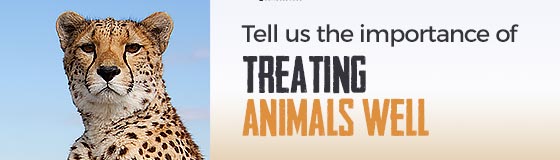
Tell us the importance of treating animals well

Tell us the importance of treating animals well
Start Date :
Sep 26, 2022
Last Date :
Oct 31, 2022
23:45 PM IST (GMT +5.30 Hrs)
Submission Closed

The importance of nature and animals has been a part of Indian culture & traditions for centuries. The 'Action Plan for Introduction of Cheetah in India’ - a landmark initiative ...

The importance of nature and animals has been a part of Indian culture & traditions for centuries. The 'Action Plan for Introduction of Cheetah in India’ - a landmark initiative to bring back Cheetahs into our ecosystem, echoes this ethos of respect for animals.

PM Narendra Modi in Mann Ki Baat urged citizens to participate in discussions regarding the importance of treating animals well. Please share your thoughts and ideas on the same.

Participate & send your ideas on the topic above and stand a chance to win a trip to see the Cheetahs at Kuno National Park!

Last Date of submission is 31st October, 2022

Reset
Showing 2790 Submission(s)
VikasKumar
VikasKumar 3 years 11 months ago
• Public awareness and education must play an essential part in teaching an environment of compassion in protecting animals with sustainable solutions to address these issues. • All these need to be discussed collectively at a global scale to make a positive impact. •There is dire need to be mindful of tackling increased urbanization, rising temperatures, and ecotourism, which are negatively contributing and fueling to affect wildlife. • Dramatic urbanization has led species living in urban environments to develop differently from their non-urban counterparts.
VikasKumar
VikasKumar 3 years 11 months ago
Best Animal Conservation ways : 1. Involve local communities in decision making like Critical tiger habitats Gram Sabha is given importance similarly the forest rights act 2. Wildlife crossings are structures that allow animals to cross human-made. More such crossings should be constructed in wildlife rich areas. 3. Primary infrastructure such as all-weather approach roads and bridges to the park should be constructed 4. Anti-poaching camps should be reconstructed. Patrolling and wildlife monitoring should be taken up on a priority basis and scientific studies to ascertain the status of key species should be undertaken with the help of research organizations.
VikasKumar
VikasKumar 3 years 11 months ago
Impact of Illegal Wildlife Trade: Species face extinction because of demands arising out of illegal wildlife trade. Overexploitation of the wildlife resources due to its illegal trade creates imbalances in the ecosystem. Illegal wildlife trade as part of the illegal trade syndicates undermines the economy of the country and thereby creates social insecurity. Wild plants that provide genetic variation for crops (natural source for many medicines) are threatened by the illegal trade.
VikasKumar
VikasKumar 3 years 11 months ago
Successful conservation introductions are a blend of best science, technology, sociological aspects and commitment of financial resources. These aspects are integrated in this Action Plan based on the modern scientific approach recommended by the latest International Union for Conservation of Nature (IUCN) guidelines for reintroduction and other conservation translocations, provides the framework for bringing back the charismatic cheetah to India.
Sudarshan Bora
Sudarshan Bora 3 years 11 months ago
The animals play the role of “keystone species” which showcase the functioning and the health of the particular ecosystem. They keep the functions of ecosystem up and running, rendering the functions useless even if a single specie dis functions ie. Their numbers falter. The prey of cheetah for example, may increase in number and lead to overgrazing in the region, which in turn may destroy the habitat of the region
RAJENDRA PRASAD MANDAL
RAJENDRA PRASAD MANDAL 3 years 11 months ago
To keep our eco system balance ,we have to provide every thing for their existence.We the human beings almost involved in social,political & economical works; our existence depends on all others animals existence.So ,we have to take care for all around.Then our future generation will be able to see & exist.
Rajveer
Rajveer 3 years 11 months ago
Cheeta is an Apex Natural Predator at the top of food chain that may leads tropic cascade. Its main prey is Herbivorous animals. It indirectly helps the over grazing by herbivorous animals. A big reason for soil erosion and helping turning the forest to barren and also helps spreading diseases. We should support increase population by providing natural environment, so that ecological balance remains correct. Save the king of speed, fast and furious
JeleettaMathew
JeleettaMathew 3 years 11 months ago
Discussions to bring the cheetah back to India were initiated in 2009 by the Wildlife Trust of India. Experts from across the world, officials of the Government of India including Ministry of Environment, Forests and Climate Change and representatives of the state governments met and decided to conduct site surveys to explore the reintroduction potential. Former cheetah range states, i.e., Gujarat, Rajasthan, Chhattisgarh and Madhya Pradesh, were prioritized. Amongst the 10 surveyed sites of the central Indian states, Kuno Palpur National Park (KNP) in Madhya Pradesh has been rated the highest. This is because of its suitable habitat and adequate prey base. KNP is 748 sq. km. in area, devoid of human settlements, forms part of Sheopur-Shivpuri deciduous open forest landscape and is estimated to have a capacity to sustain 21 cheetahs. Kuno is probably the only wildlife site in the country where there has been a complete relocation of villages from inside the park.
JeleettaMathew
JeleettaMathew 3 years 11 months ago
India is going to be home once again to the majestic presence of cheetah, the world’s fastest land animal. Yes, the Government of India has decided to reintroduce cheetahs, under the 'Action Plan for Introduction of Cheetah in India’. Unveiling the action plan, Union Minister for Environment, Forest and Climate Change, Shri Bhupender Yadav informed that Prime Minister Shri Narendra Modi is keen on the protection and conservation of seven major big cats including Cheetah. “Project Cheetah aims to bring back independent India’s only extinct large mammal – the cheetah. As part of the project, 50 cheetahs will be introduced in various National Parks over five years.”Cheetah happens to be the only large carnivore that got completely wiped out from India, mainly due to over-hunting and habitat loss. The Action Plan highlights the nation’s preparedness in bringing the cheetah back. Conservation of Cheetahs has a very special significance for the national conservation ethic and ethos.