
Home | MyGov

Accessibility
ऐक्सेसिबिलिटी टूल
कलर एडजस्टमेंट
टेक्स्ट साइज़
नेविगेशन एडजस्टमेंट

राष्ट्रीय युवा नीति के मसौदे पर सुझाव आमंत्रित

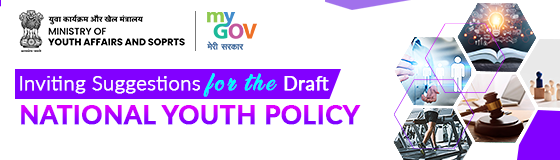
Inviting Suggestions for the Draft National Youth Policy
आरंभ करने की तिथि :
Jun 08, 2022
अंतिम तिथि :
Jul 15, 2022
23:45 PM IST (GMT +5.30 Hrs)
प्रस्तुतियाँ समाप्त हो चुके

सरकार ने मौजूदा राष्ट्रीय युवा नीति, 2014 के मसौदे की समीक्षा करते हुए ...

सरकार ने मौजूदा राष्ट्रीय युवा नीति, 2014 के मसौदे की समीक्षा करते हुए एक नया राष्ट्रीय युवा नीति (एनवाईपी) मसौदा तैयार किया है। राष्ट्रीय युवा नीति के मसौदे में युवा विकास के लिए दस साल तक के विजन की परिकल्पना की गई है जिसे भारत 2030 तक हासिल करेगा। यह सतत विकास लक्ष्यों (एसडीजी) के साथ जुड़ा हुआ है जिसका उद्देश्य 'भारत को आगे बढ़ाने के लिए युवाओं की क्षमता का पूरी तरह से इस्तेमाल करना' है। एनवाईपी के नए मसौदे का लक्ष्य युवाओं के विकास के लिए पांच प्राथमिकता वाले क्षेत्रों पर काम करना है जिनमे शिक्षा; रोजगार और उद्यमिता: युवा नेतृत्व और विकास; स्वास्थ्य, फिटनेस और खेल; एवं सामाजिक न्याय शामिल है। प्रत्येक प्राथमिकता वाले क्षेत्र में वंचित वर्ग के हितों का ध्यान रखते हुए सामाजिक समावेशन के सिद्धांत पर आधारित किया गया है।

युवा मामले विभाग सभी हितधारकों से एनवाईपी के मसौदे पर विचार/सुझाव आमंत्रित करता है।

नीति दस्तावेज़ देखें: ड्राफ्ट राष्ट्रीय युवा नीति (PDF 150 MB)

विचार और सुझाव साझा करने की अंतिम तिथि 15 जुलाई, 2022 है।

फिर से कायम कर देना
1180 सबमिशन दिखा रहा है
Pankaj Kumar Jain
Pankaj Kumar Jain 3 साल 10 महीने पहले
N.C.C. and scout should be compulsory from class V to X and optional till XII. Best cadets should be given opportunity tof camping/training in Indian Army. Compulsory visit to Vridha Aashram and Child Homes with contribution of small amount of donation Rs.1 or 2 only from their pocket money).. Plantation once in every month of monsoon (4 months). class I to X compulsory period of Moral education for educating honesty and bravery, Indian Culture. Class VII to X the students should be given complete training of I.T.I.
Nasur uddin
Nasur uddin 3 साल 10 महीने पहले
Dear sir I have a suggestion/requisition that the policy of engaging professional youth on contractual basis in many departments of Jammu and Kashmir for running of many centrally sponsored schemes may be stopped /banned so that their career is not spoiler. There are hundreds of families at this moment who can not beg as well or go for the labour type works nor can opt or apply for other jobs because of the age factor. They have now become destitutes. Being one of them I want to shre some moments that none other can have experienced even being able to do any task related to my job. I am working as cic operator in RDD department since last 16 years on mere 10000/ a month having a family of 4 members with no other income at all. Sometimes I feel that there is no option for me rather to suicide but think of my family. Approached all the higher officials we are being made to wander from one door to another. I will be very thankful if my suggestions / requisition is given some regard.
Anu
Anu 3 साल 10 महीने पहले
कला वर्ग की शिक्षा कला वर्ग के शिक्षक सफेद हाथी हैं। कला वर्ग की शिक्षा पर नियंत्रण लगाया जाए। कला वर्ग के शिक्षक खाते तो हैं परन्तु कमाते नहीं हैं। जब खाने वाले अधिक और कमाने वाले कम होते हैं तो महंगाई डायन गरीबों को परेशान करती है।
Anu
Anu 3 साल 10 महीने पहले
जवाहर नवोदय विद्यालय ये विद्यालय अनावश्यक हैं। इन विद्यालयों को समाप्त करा जाए। जब खाने वाले अधिक और कमाने वाले कम होते हैं तो महंगाई डायन परेशान करती है।
Anujbhardwaj
Anujbhardwaj 3 साल 10 महीने पहले
respected Sr/madam , as a youth and upcoming management graduate I would like to suggest that skillful and technical certification course should be encouraged more before than ever especially in semi-urban/rural areas of our country and the system should be based on PPP model . based on my personal experience on visit to PPP sites i found this system better than other as results, regrowth, reassessment, performance, facilities and development of youth surely be improved by this steps and methods. but a strong challenge also lies ahead of transparency and honesty of the institution given these responsibility .in particularly the private education institute with utmost credibility should be given chance . secondly it should not be free but for all eligible sections of society. conclusion - diploma and certificate courses should be incouraged and should have neccessary value by gov of india and should be counted in portfolio . #aatmanirbharbharat
Ajinkya Rajendra Kolkar
Ajinkya Rajendra Kolkar 3 साल 10 महीने पहले
National Health Policy -2017 is an effort in the direction of improving healthcare in the country. A Few of the schemes implemented by the government to provide quality health care include – POSHAN Abhiyaan, Ayushman Bharat, Pradhan Mantri Matru Vandana Yojana, etc. Khelo India and Sports Revitalization Action Plan are a few of the initiatives of the government which were focused on developing the culture of sports which in turn is expected to contribute to health. The establishment of India’s first Sports University is one of the tangible outcomes of the initiatives regarding sports.
Ajinkya Rajendra Kolkar
Ajinkya Rajendra Kolkar 3 साल 10 महीने पहले
To ensure that the monitoring of the indicators is in place and is measurable, the NYP-2014 recommended: Baseline assessment to be done and annual target set for each of the indicators Status of Youth Report to be published every two years. Review of NYP-2014 to be done every 5 years. As highlighted earlier, NYP-2014 provides a larger framework based on which the union & the respective state governments need to formulate policies and programmes. Further, while NYP-2014 highlights the need for indicators and targets to be put in place in order to measure progress, it does not define the targets. For example, it recognizes that the Government of India is spending approximately Rs. 2,710 (in 2014) on every young individual through various ministries and schemes of which Rs. 1,100 is through targeted programs. It notes that the government needs to invest more but does not mention the quantum of investment which could act as a measurable target to evaluate.
Ajinkya Rajendra Kolkar
Ajinkya Rajendra Kolkar 3 साल 10 महीने पहले
National Youth Policy 2021 aligned with Sustainable Development Goals In its announcement of introducing a new Draft National Youth Policy – 2021, the government does not highlight any shortcomings of NYP-2014, which necessitated the need for developing a new draft policy. As highlighted above, a few of the indicators related to various schemes show progress. However, the exact extent of progress with respect to any specific targets cannot be ascertained, to evaluate the success in line with NYP-2014. NYP-2021 seeks to provide a 10-year vision for youth development by 2030. A key aspect of NYP-2021, which is not included in NYP-2014 is the alignment with Sustainability Development Goals. NYP -2021 identifies 5 priority areas – Education, Employment & Entrepreneurship, youth leadership & development; health, fitness & sports; and social justice.
Ajinkya Rajendra Kolkar
Ajinkya Rajendra Kolkar 3 साल 10 महीने पहले
The Gross Enrolment Ratio (GER) for Higher Education (18-23 age group) increased from 24.3 in 2014-15 to 27.1 in 2019-20. Data from AISHE reports also indicate that GER has continued to increase among females. While the GER among marginalized sections of society is lower than others, there is an improvement over the years. Factly has earlier written on this, which can be read here and here. While the extent of the impact of government initiatives on this improvement cannot be ascertained, bridging the gaps in access to education was one of the key objectives as part of NYP-2014. The policy document for NYP-2021 highlights other improvements in areas of employment and entrepreneurship, which includes 1.1 crores of jobs generated under the Pradhan Mantri MUDRA Yojana (PMMY) between 2015 & 2017. PMMY’s Annual Report for 2020-21 states that the total support extended through the scheme in the last 6 years is around Rs. 15 lakh crores.
Ajinkya Rajendra Kolkar
Ajinkya Rajendra Kolkar 3 साल 10 महीने पहले
Youth form a vital demographic and are key to the success and progress of a nation. Most of the global ‘Sustainable Development Goals’ (SDGs) have youth as a focus area, emphasizing the importance of the young population and the need for investing in them. India has the largest youth population in the world with one out of every four among the 15-29 years age group globally being Indian. They constitute nearly 34% of India’s total population. Despite a projected decline in their share, it is estimated that India would have 365 million youth by 2030, which constitutes 24% of the population. With other countries like China, the USA, and Japan battling issues with an aging population, this is a resource that India can take advantage of. With a vision for youth development in India for this decade, the Government of India has prepared a new draft National Youth Policy, 2021. This new draft is developed after a review of the existing National Youth Policy, 2014.