- Chandigarh UT
- Creative Corner
- Dadra Nagar Haveli UT
- Daman and Diu U.T.
- Department of Administrative Reforms and Public Grievances
- Department of Biotechnology
- Department of Commerce
- Department of Consumer Affairs
- Department of Industrial Policy and Promotion (DIPP)
- Department of Posts
- Department of Science and Technology
- Department of Telecom
- Digital India
- Economic Affairs
- Ek Bharat Shreshtha Bharat
- Energy Conservation
- Expenditure Management Commission
- Food Security
- Gandhi@150
- Girl Child Education
- Government Advertisements
- Green India
- Incredible India!
- India Textiles
- Indian Railways
- Indian Space Research Organisation - ISRO
- Job Creation
- LiFE-21 Day Challenge
- Mann Ki Baat
- Manual Scavenging-Free India
- Ministry for Development of North Eastern Region
- Ministry of Agriculture and Farmers Welfare
- Ministry of Chemicals and Fertilizers
- Ministry of Civil Aviation
- Ministry of Coal
- Ministry of Corporate Affairs
- Ministry of Culture
- Ministry of Defence
- Ministry of Earth Sciences
- Ministry of Education
- Ministry of Electronics and Information Technology
- Ministry of Environment, Forest and Climate Change
- Ministry of External Affairs
- Ministry of Finance
- Ministry of Health and Family Welfare
- Ministry of Home Affairs
- Ministry of Housing and Urban Affairs
- Ministry of Information and Broadcasting
- Ministry of Jal Shakti
- Ministry of Law and Justice
- Ministry of Micro, Small and Medium Enterprises (MSME)
- Ministry of Petroleum and Natural Gas
- Ministry of Power
- Ministry of Social Justice and Empowerment
- Ministry of Statistics and Programme Implementation
- Ministry of Steel
- Ministry of Women and Child Development
- MyGov Move - Volunteer
- New Education Policy
- New India Championship
- NITI Aayog
- NRIs for India’s Growth
- Open Forum
- PM Live Events
- Revenue and GST
- Rural Development
- Saansad Adarsh Gram Yojana
- Sakriya Panchayat
- Skill Development
- Smart Cities
- Sporty India
- Swachh Bharat (Clean India)
- Tribal Development
- Watershed Management
- Youth for Nation-Building
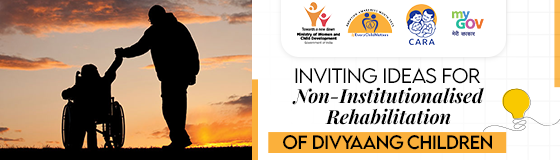
Inviting Ideas for Non-Institutionalised Rehabilitation of Divyaang Children

Start Date :
Oct 01, 2025
Last Date :
Nov 30, 2025
17:30 PM IST (GMT +5.30 Hrs)
In 2025, the Central Adoption Resource Authority (CARA) is placing special focus on promoting family-based care for children with special needs (Divyaang children). In ...
All Comments
Featured
New Comments
Comments (2)
Comments (2)
Comments (1)
Comments (1)
Comments (2)
Comments (1)
Comments (2)
Comments (2)
Comments (1)
Comments (1)
Showing 777 Submission(s)
Dr TASHANT ANEJA
1 year 2 weeks ago
1)I HAVE ONE IDEA. WHICH MAY HELP FINDING THE RIGHT PARENTS FOR. DISABLED CHILD.
A APP WHICH WORK LIKE METRIMONIAL APP.
THIS IS HOW IT WORKS:-
PROFILE OF PARENTS WILL BE PUT ONLINE ON PORTAL . BOTH CHILDERN AND PARENTS CAN SWIPE RIGHT ON IT. THEN DETAILED VERSION OF BOTH PARTY WILL BE OPEN.
2) CONNECTING CHILDERN ONLINE TO EACH OTHER WILL HELP TOO. BASED UPON THERE DISABILITY THEY CAN CONNECT TO EACH OTHER.LERAN AND TEACH EACH OTHER SKILLS.BECAUSE CARING A DISABLED CHILD IS WHOLE ALOT OF WORK. SO MAKING THEM INDEPENDENT IS IMPORTANT. SO THEY ARE ACCEPTED EASILY BY PARENTS.
3) REHABILITATION CENTRE WHERE CHILDERN ARE IN CONSTANT CONNECTION WITH HOSPITALS. WHERE THEY ARE TAUGHT ACCORDING TO THERE DISABILITY. REGULAR FREE SESSIONS. HERE PARENTS CAN COME TOO TO SEE IF THEY FIND A MATCH.
4) PROVIDING SCHOLARSHIPS TO STUDENTS WHO HAS EXPERIENCE IN WORKING IN THESE REHAB CENTRES WILL ATTRACT MORE WORK FORCE .CAN BE A NURSE, OR PHYSIOTHERAPIST OR ORTHO ASSISTANT. GIVING THEM POINTS IN NEET UG
Like
(5)
Dislike
(1)
Reply
Report Spam
GARAIYA AKSHAY
1 year 2 weeks ago
Adoption processes for Divyaang children are fraught with procedural hurdles, including exhaustive documentation and home studies that intimidate prospective families, despite legal safeguards under child welfare laws. Many children in unregulated care homes remain off the radar, invisible to matching systems that prioritize healthier profiles due to unfounded fears of added responsibilities. Insights shared by adopters and advocates could demystify these steps, emphasizing the joys and support systems available, to encourage more inclusive placements.
Like
(5)
Dislike
(1)
Reply
Report Spam
GARAIYA AKSHAY
1 year 2 weeks ago
Community-based rehabilitation thrives on multi-level involvement, from local self-help groups training caregivers to schools incorporating inclusive curricula, yet resource shortages hinder widespread rollout. Vocational programs tailored for teens with special needs often feel tokenistic, lacking real-world applicability. Shared ideas on the platform might include mentorship pairings or skill-sharing workshops, turning barriers into collaborative opportunities for sustainable growth.
Like
(8)
Dislike
(1)
Reply
Report Spam
GARAIYA AKSHAY
1 year 2 weeks ago
Legal frameworks provide a foundation but fall short in specifics for Divyaang adoptions, such as streamlined guardianship for those with cognitive challenges, leaving gaps in enforcement and awareness. Coordination between agencies often lags, stranding children in limbo. Citizens could use the platform to flag these inconsistencies, proposing reforms like dedicated adoption counselors to expedite matches and integrate rehabilitation plans from the outset.
Like
(7)
Dislike
(1)
Reply
Report Spam
GARAIYA AKSHAY
1 year 2 weeks ago
Adoption processes for Divyaang children are fraught with procedural hurdles, including exhaustive documentation and home studies that intimidate prospective families, despite legal safeguards under child welfare laws. Many children in unregulated care homes remain off the radar, invisible to matching systems that prioritize healthier profiles due to unfounded fears of added responsibilities. Insights shared by adopters and advocates could demystify these steps, emphasizing the joys and support systems available, to encourage more inclusive placements.
Like
(8)
Dislike
(1)
Reply
Report Spam
GARAIYA AKSHAY
1 year 2 weeks ago
Cultural stigma emerges as a formidable barrier, with disabilities sometimes perceived as familial burdens or karmic afflictions, prompting parents to conceal rather than seek help. This reluctance not only delays identification but also perpetuates cycles of isolation, affecting siblings and extended families alike. Personal testimonies on the platform could humanize these struggles, challenging outdated beliefs through narratives of resilience and normalcy, thereby cultivating a supportive network that normalizes seeking assistance.
Like
(7)
Dislike
(1)
Reply
Report Spam
GARAIYA AKSHAY
1 year 2 weeks ago
Cultural stigma emerges as a formidable barrier, with disabilities sometimes perceived as familial burdens or karmic afflictions, prompting parents to conceal rather than seek help. This reluctance not only delays identification but also perpetuates cycles of isolation, affecting siblings and extended families alike. Personal testimonies on the platform could humanize these struggles, challenging outdated beliefs through narratives of resilience and normalcy, thereby cultivating a supportive network that normalizes seeking assistance.
Like
(6)
Dislike
(1)
Reply
Report Spam
GARAIYA AKSHAY
1 year 2 weeks ago
Socio-economic constraints compound identification challenges, as low-income households prioritize survival over specialized evaluations, resulting in untreated conditions that worsen over time. In many areas, transportation costs to urban centers for testing deter follow-through, while digital divides limit access to online awareness resources. By voicing these realities on the collaborative space, citizens can propose low-cost innovations, like mobile screening vans or peer-led awareness drives, to democratize early detection and ensure no child slips through the cracks.
Like
(5)
Dislike
(1)
Reply
Report Spam
GARAIYA AKSHAY
1 year 2 weeks ago
Identification of Divyaang children often stumbles at the grassroots level due to inconsistent screening mechanisms and overburdened primary health systems, particularly in remote villages where basic diagnostics are scarce. Frontline workers, such as those in early childhood centers, frequently lack specialized training to recognize subtle signs of conditions like autism or developmental delays, leading to overlooked cases. Platform users could share anecdotes of missed opportunities, such as families navigating language barriers during assessments, to advocate for simplified, multilingual tools that empower communities to act swiftly and prevent escalation of needs.
Like
(6)
Dislike
(1)
Reply
Report Spam
- View More